Capitol Hill is the neighborhood most people think they know before they’ve ever walked it. They’ve seen the dome. They’ve watched the hearings. They know the address. What they don’t know is that three blocks east of the Capitol building, the city goes completely quiet — brick sidewalks, iron fences, rowhouses with front gardens, neighbors who’ve lived on the same block for thirty years. Capitol Hill is where Washington DC stops performing and starts actually living.
What Capitol Hill Actually Is
Capitol Hill is both a neighborhood and a state of mind. Officially it covers roughly 2 square miles east of the Capitol building, bounded by the Capitol grounds to the west, the Anacostia River to the southeast, and H Street NE to the north. But the neighborhood’s identity is defined less by its borders than by its character — Victorian rowhouses, brick sidewalks, and a community of people who chose to live next door to American democracy and then got on with their lives.
The Hill has been a residential neighborhood since the early 1800s. Members of Congress boarded here when Washington was still a mud-road city. Abolitionists lived here. Frederick Douglass made his home nearby in Anacostia. The neighborhood survived urban decline in the 1970s and a long, slow return in the decades after. What came back was something genuinely rare in DC — a neighborhood with both history and continuity, where the architecture tells the story because the people stayed long enough to protect it.
The Rowhouses
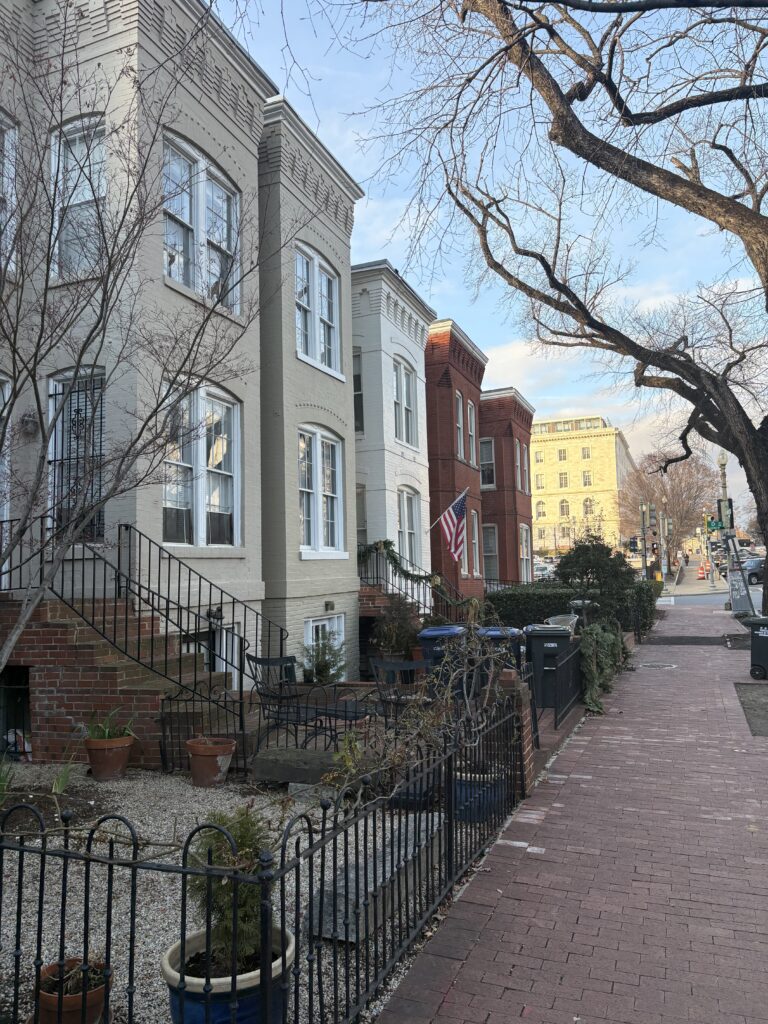
The Capitol Hill rowhouse is one of DC’s great architectural achievements. Built between the 1860s and 1910s in styles ranging from Italianate to Queen Anne to Federal, they line the residential blocks in unbroken rows of red and yellow brick, painted wood, ornate cornices, and iron fences. Front gardens range from meticulously maintained to cheerfully wild. American flags hang from facades. Potted plants crowd the stoops.
Walking the residential blocks — C Street SE, Independence Avenue SE, 4th Street SE, East Capitol Street — gives you a version of DC that has nothing to do with government and everything to do with people who built a real neighborhood in the shadow of the most powerful building in the country.
Eastern Market: The Neighborhood’s Anchor
Eastern Market at 7th Street and North Carolina Avenue SE is the heart of Capitol Hill neighborhood life. Built in 1873 and operating continuously ever since — surviving a serious fire in 2007 and reopening in 2009 after a full restoration — it’s one of DC’s oldest public markets and one of its most genuinely alive.
Inside the South Hall on weekdays and Saturdays, local vendors sell meat, fish, cheese, produce, and prepared food. The flea market spreads across the plaza on weekends with antiques, art, and local crafts. The farmers market runs Saturday and Sunday mornings. Lunch at the Market Lunch counter — corn cakes, crab cakes, blueberry bucks — is a Capitol Hill institution.
Eastern Market is where the neighborhood actually happens. On a Saturday morning, you’ll see staffers picking up groceries, families with strollers, longtime Hill residents who’ve been coming for decades, and visitors who stumbled off the Metro and found something they weren’t expecting.
The Commercial Strips
Capitol Hill’s main commercial life runs along two corridors — Pennsylvania Avenue SE and Barracks Row on 8th Street SE.
Pennsylvania Avenue SE is the neighborhood’s main street — a mix of restaurants, bars, coffee shops, and independent businesses running from the Capitol grounds east toward the Anacostia. Bullfeathers at 410 First Street SE is the classic Hill bar — a place where lobbyists, staffers, and longtime residents have been sharing booths since 1983. Talay Thai nearby is a neighborhood staple. The coffee shops along Pennsylvania fill with laptops and Hill staff on weekday mornings.
Barracks Row on 8th Street SE is the Hill’s restaurant corridor — one of DC’s most consistently strong dining strips with options at every price point. The Marine Barracks at the south end of 8th Street is the oldest active post in the Marine Corps, dating to 1801. Friday Evening Parades in summer are open to the public and genuinely worth attending.
Getting Around Capitol Hill
Capitol Hill is one of DC’s most walkable neighborhoods and one of its best-served by transit. Capitol South station (Blue/Orange/Silver Line) sits at the corner of First Street and C Street SE — two blocks from the Capitol Visitor Center and a 10-minute walk to Eastern Market. Eastern Market station (Blue/Orange/Silver Line) sits directly adjacent to Eastern Market on 7th Street SE.
Capital Bikeshare stations are throughout the neighborhood — the Hill’s flat terrain and relatively low traffic make it one of DC’s best biking neighborhoods. Several stations sit along Pennsylvania Avenue SE and near Eastern Market.
For drivers, Capitol Hill is Zone 6 RPP — the residential blocks require permits for parking beyond 2 hours between 7am and 8:30pm Monday through Saturday. Street parking is competitive near the Capitol complex and Eastern Market on weekends. Read our full guide to parking near the US Capitol before you drive in.
Lincoln Park: The Neighborhood’s Green Space
Lincoln Park at East Capitol Street and 11th Street NE is Capitol Hill’s main public green space — an elongated park running several blocks along East Capitol Street. Two significant statues anchor the park: the Emancipation Memorial (1876), depicting Lincoln with a freed enslaved man, and the Mary McLeod Bethune Memorial (1974), the first statue of a Black woman on public land in DC.
On weekday mornings the park fills with dog walkers and joggers. Weekend afternoons bring families and pickup soccer. It’s the kind of neighborhood park that actually functions as a neighborhood park — used daily, known by name, the place people tell you to meet them.
Who Lives on Capitol Hill
Capitol Hill is one of DC’s most demographically mixed neighborhoods — a combination of longtime Black families who have lived here for generations, Hill staffers and young professionals drawn by the transit access and walkability, members of Congress who keep apartments here during session, and families who arrived in the 1980s and 90s and never left.
The neighborhood has gentrified significantly since the 1990s but retains more diversity than most comparable DC neighborhoods. The presence of Eastern Market, the strong civic associations, and the historic preservation rules that protect the architecture have all contributed to a neighborhood that feels less replaced than many DC areas that went through similar transitions.
If You’re Visiting
Capitol Hill rewards slow walking. The Supreme Court and Library of Congress are a 5-minute walk from the Capitol Visitor Center. Eastern Market is a 15-minute walk southeast. Lincoln Park is 20 minutes on foot heading east along East Capitol Street. The Marine Barracks on 8th Street SE is a 15-minute walk south.
The neighborhood is best experienced on foot on a weekday morning or Saturday — when Eastern Market is running, the coffee shops are full, and the residential blocks are alive without being overrun. Sunday afternoon is quieter and beautiful for walking the rowhouse blocks.
For the Capitol building itself, read our full guide to visiting the US Capitol — tours require advance reservations and the logistics are worth knowing before you arrive.
🎟️ Capitol Hill Walking Tour
The Original Capitol Hill Small Group Walking Tour takes you through the neighborhood’s history, architecture, and political landscape with a guide who actually knows the Hill. 4.8 stars, max 15 people, free cancellation.
If You’re Moving to Capitol Hill
Capitol Hill is one of DC’s most livable neighborhoods for people who want urban density without urban chaos. The Metro access is excellent — two stations, multiple lines, easy connections to downtown and Reagan National. The walkability is genuine — groceries, restaurants, hardware stores, and a farmers market all within a 10-minute walk of most addresses.
Housing runs the full spectrum from studio apartments to full Victorian rowhouses. The Hill has historically been more affordable than Georgetown or Dupont Circle for comparable housing quality, though prices have risen significantly in the last decade. The zip codes to know are 20002 (north Capitol Hill) and 20003 (south Capitol Hill near Eastern Market and Barracks Row).
Schools in the Capitol Hill cluster include Peabody Elementary, Maury Elementary, and Stuart-Hobson Middle School — all part of DC Public Schools. The neighborhood has active civic associations that are worth knowing about before you move.
🏨 Staying on Capitol Hill?
Several hotels and vacation rentals sit within walking distance of the Capitol, Eastern Market, and the main neighborhood commercial strips — no car needed for any of it.
Quick Reference: Capitol Hill DC
- Location: East of the Capitol building, Southeast/Northeast DC
- Metro: Capitol South + Eastern Market (Blue/Orange/Silver Line)
- Parking: Zone 6 RPP — 2-hour limit on residential blocks
- Main market: Eastern Market — open daily, flea market weekends
- Main restaurant strip: Barracks Row, 8th Street SE
- Main bar: Bullfeathers, 410 First Street SE
- Green space: Lincoln Park, East Capitol & 11th Street NE
- Best walk: Pennsylvania Ave SE → Eastern Market → Barracks Row
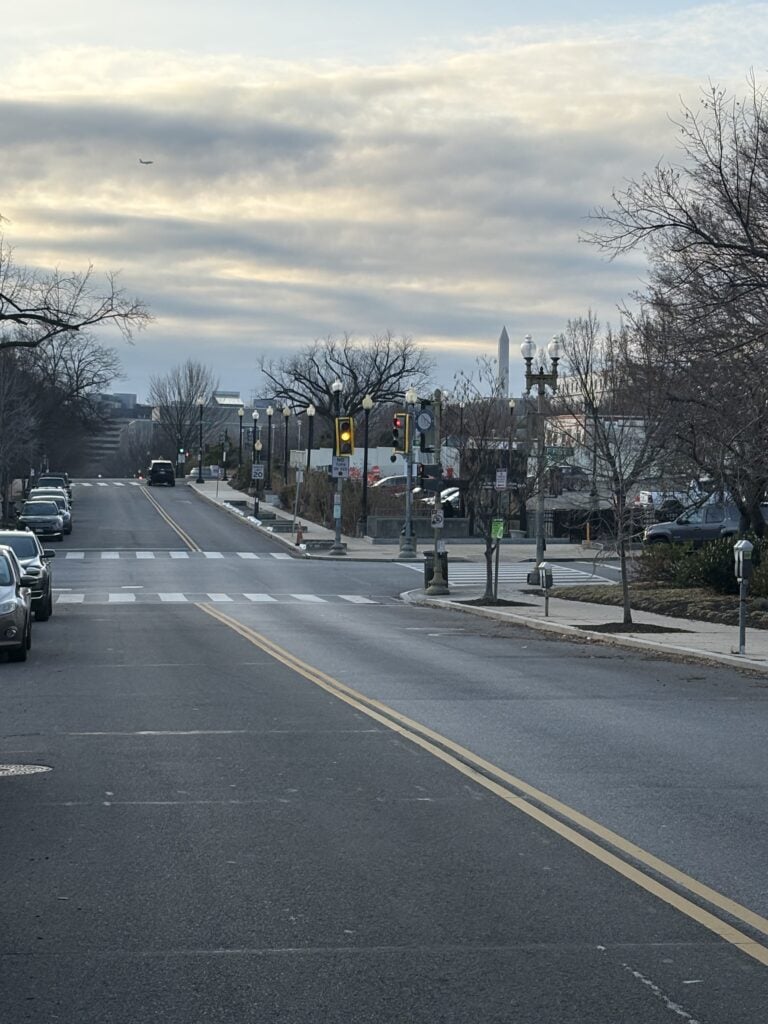
- Best photo: Pennsylvania Ave SE looking west toward Washington Monument
- Zip codes: 20002 (north), 20003 (south)